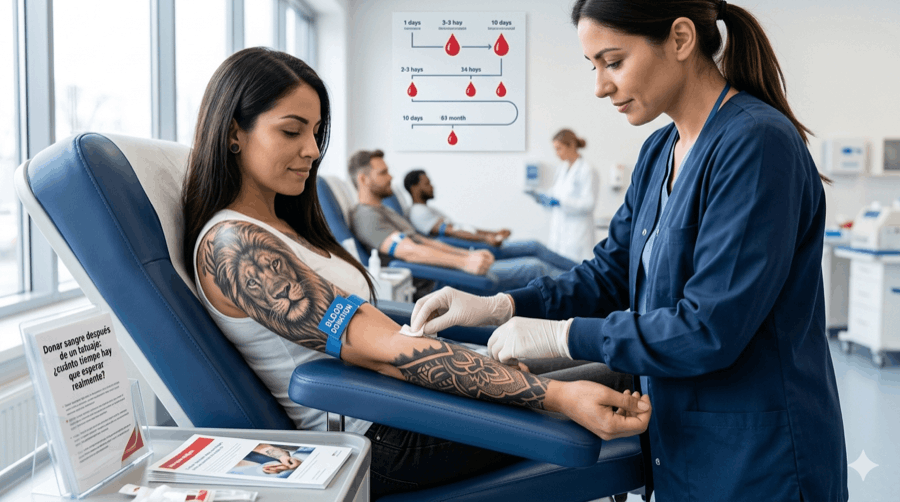
Many people are surprised to learn they can’t donate blood immediately after getting a tattoo. Sometimes the waiting period is months, and in some countries or centers it can vary depending on where you were tattooed or under what conditions. That naturally raises questions: is it the ink, the healing, infection risk, or something else?
The answer is less about “what tattooing does to your blood” and more about a public health principle: minimizing the risk of transmitting blood-borne infections. Waiting periods are designed to cover the time window in which a recent infection might not yet be reliably detectable on screening tests.
Why a waiting period exists
Tattooing involves needles and skin puncture. If conditions are not safe, there’s a risk of exposure to blood-borne pathogens. Professional studios reduce that risk with sterile, single-use materials and strict protocols, but blood banks operate with conservative standards because their priority is protecting recipients.
Even if you were tattooed in an impeccable studio, a blood bank can’t audit each individual session. That’s why many regulations apply uniform waiting periods: they don’t evaluate your artist; they evaluate the tattoo event as a potential exposure scenario.
This can feel unfair when you chose a high-quality studio, but it’s consistent with how other risks are handled—erring on the side of caution to protect the blood supply.
The testing "window": the key concept
The technical reason is the diagnostic window. Some infections take time to become detectable after exposure, depending on the tests used. During that window, a person could be infected while a test still reads negative.
Waiting periods are designed so that if something did happen, enough time passes for screening tests to detect it more reliably.
It’s not a moral judgment and it’s not "anti-tattoo". It’s a statistical safety buffer for a critical system.
Why the timeline differs by country or center
Waiting periods depend on national regulations, local blood service policies, and which screening tests are used. In systems with highly sensitive testing and regulated studios, some places allow shorter waits if the tattoo was done in a licensed facility.
In other places, the rule may be longer or uniform with no exceptions. That’s why relying on internet anecdotes is a mistake—the only rule that matters is the one from the blood bank where you plan to donate.
- Factors that commonly influence the requirement:
- Whether the tattoo was done in a regulated studio versus an informal setting.
- Which screening tests the center uses.
- Current national/regional rules.
- Other added risk factors (travel, recent procedures, etc.).
Is the ink itself the issue?
The ink is not the main reason for waiting periods. The concern isn’t that ink "contaminates" your blood, but that the procedure could involve exposure if sterility wasn’t guaranteed. Ink is mostly a skin-local topic, not a blood donation topic.
Your body is healing and inflamed in the first days, but that isn’t what drives months-long waiting rules. The dominant factor is managing transmission risk during the testing window.
In short: the blood bank isn’t saying tattoos are “bad.” It’s applying a population-level safety rule.
What to do if you want to donate and you were tattooed recently
The most useful step is to call or check the official website of the blood bank you plan to visit. Ask the exact waiting period for tattoos and whether licensed-studio exceptions exist. Document the answer and plan your donation date accordingly.
If you’re donating for a specific reason (a family member, a campaign), planning matters. Getting tattooed right before can exclude you from the window, which is frustrating. If donating is important to you, schedule tattoos in times that won’t interfere with your donation goals.
If you already got tattooed, don’t beat yourself up. Wait the required time, heal well, and donate when you’re eligible. Donating blood is valuable, and doing it at the right time protects everyone.


