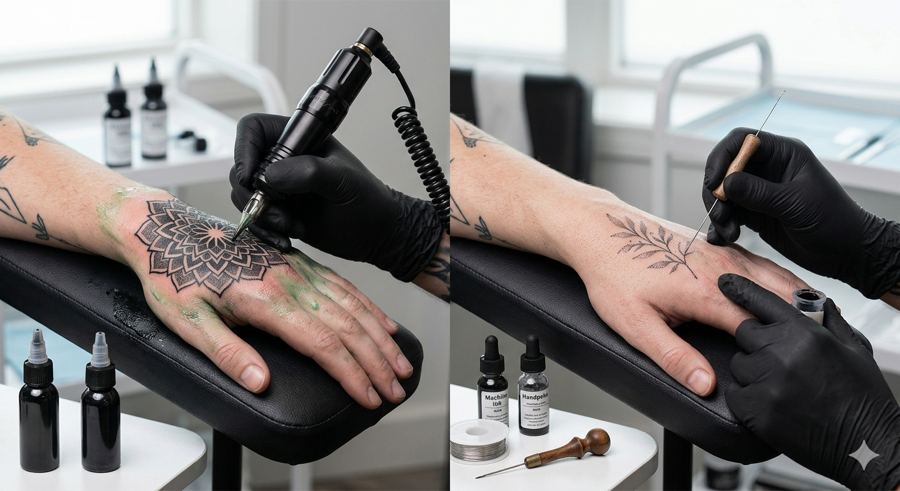
In recent years, handpoke (manual, machine-free tattooing) has become more visible. For some, it feels intimate and artisanal; for others, it raises questions: does it last less? Does it hurt more or less? Is it less professional?
The truth is that neither handpoke nor machine work is "better" by default. The real difference comes from who’s behind the tool, how they design, and how they place ink in your skin. This article breaks down the real differences so you can choose with confidence.
What handpoke tattoos are—and what they aren’t
Handpoke tattoos are done by manually piercing the skin with a sterile needle (or needle cartridge) without an electric machine. That doesn’t mean improvisation: a good handpoke artist follows the same hygiene, materials, and care standards as a machine-based artist.
The main change is rhythm: instead of thousands of punctures per minute from a machine, the artist works point by point by hand. That’s why handpoke is often associated with simpler designs, delicate lines, dots and patterns—though some push it into more complex territory.
What handpoke is not is "sticking yourself with anything" at home without hygiene. If someone isn’t using proper materials, gloves, and disinfection, the risk is the same (or worse) than with a poorly used machine.
Differences in how pain feels
Many people describe handpoke as a more focused, gentler-feeling process, without the noise and vibration of a machine. The slower rhythm and quieter environment can feel less overwhelming.
But the pain doesn’t vanish—you’re still getting micro-punctures. For small to medium pieces, this can feel very manageable. For large projects, both total session time and accumulated sensitivity matter.
Machine tattoos can feel more intense at first (due to vibration and speed), but they can also be completed faster in many designs, reducing overall exposure time. Ultimately, pain perception depends as much on your body and the artist’s technique as on the tool.
Healing and longevity: do handpokes fade faster?
A well-executed handpoke can last just as long as a machine tattoo. The myth that they "fade faster" usually comes from poorly executed pieces—ink not consistently placed in the dermis—or from ultra-fine designs that are inherently delicate regardless of method.
Healing can sometimes feel gentler because localized trauma per square centimeter can be lower (depending on design), but there’s no universal rule. Your skin still needs gentle washing, proper cream, and sun protection either way.
- Longevity factors beyond the technique:
- Body area (friction, sun exposure).
- Line weight and detail level.
- Healing and long-term aftercare habits.
- Ink quality and correct depth.
Aesthetics: when handpoke or machine make sense
Handpoke has a beautiful aesthetic for minimal work, patterns, dots, symbols, and certain organic styles. It can give a subtle texture and visual rhythm, especially when the design intentionally leans into that character.
For large solid-color fields, heavy blackwork, or complex realism, machine work is usually more efficient and consistent. It’s not impossible by hand, but session times can become very long and demanding for both artist and client.
Choosing handpoke or machine also relates to the experience you want: quieter, slower, more intimate sessions vs faster, highly technical sessions for big pieces.
How to decide what’s right for you
Instead of starting with the tool, start with your tattoo. Define size, placement, style, and detail. Then look for artists who consistently do strong work in that lane—handpoke or machine.
If you love handpoke aesthetics and your idea fits its strengths, it can be a great choice. If you want a large, densely saturated or highly realistic tattoo, focusing on machine specialists in that style is usually smarter.
At the end of the day, in both handpoke and machine work, quality comes from the combination of thoughtful design, solid technique, and good aftercare—not from whether you heard a motor during your session.


