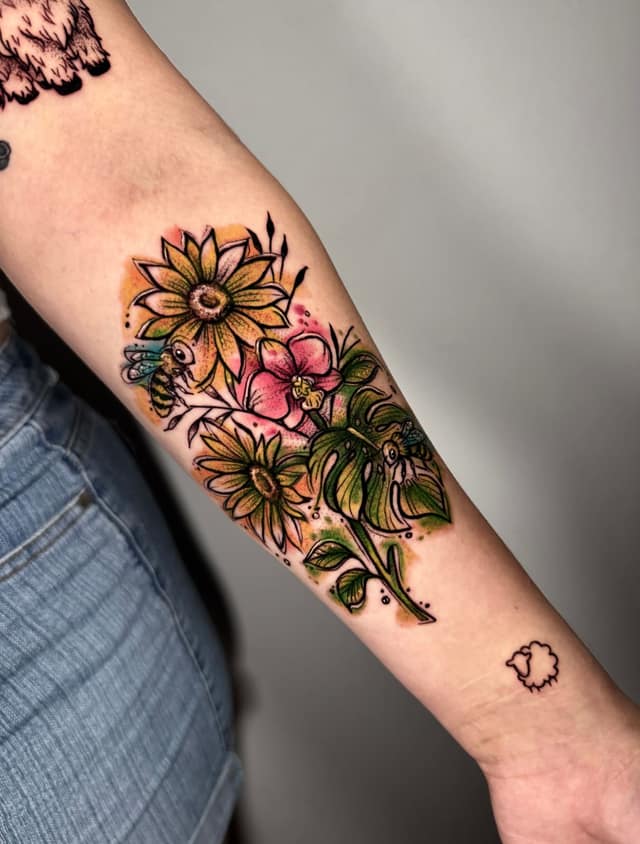
Yes, you can turn an abdominoplasty or C-section scar into a botanical tattoo, as long as the tissue has fully matured, which usually takes at least a year and should be confirmed by your surgeon. Botanical designs work better than geometric or realistic ones because their organic shapes adapt to the tension and irregularities of the operated abdomen.
Major abdominal interventions, such as an abdominoplasty or "tummy tuck," often involve extensive horizontal resections that run along the pelvic anatomy. Dealing with the long-term aesthetic results and recovery, post-surgical tattooing has emerged not simply as a "concealment" method, but as a fundamental restructuring of the psychological relationship with one's own body. Botanical design orchestrates the perfect balance for these complex areas.
Structural dynamics of the post-surgical abdomen
The lower abdominal area subjected to a tummy tuck loses its natural skin laxity. The tissue is subjected to sustained diametric tension to maintain the new silhouette. From a technical tattooing perspective, this means working over fibrous tissue that may have varying neurological sensitivities: some patients report numbness (hypoesthesia), while others experience hypersensitivity. Furthermore, the scar is three-dimensional, presenting topographic peaks and valleys.
The mathematical advantages of botanical art
Attempting to tattoo a portrait, a perfect geometric compass, or a hyper-realistic element directly onto an abdomen with topographic alterations is a recipe for visual distortion. The human body around the hips and abdomen curves on three-dimensional axes when sitting, walking, or bending over.
Botanical and floral art lacks rigid, mandatory mathematical proportions. A curved branch, loose foliage, or an overlapping peony utilize something called **visual pattern disruption**. As the petals flow asymmetrically crossing and bordering the incision line, the viewer's brain no longer perceives the straight surgical line, but rather the dominant organic design.