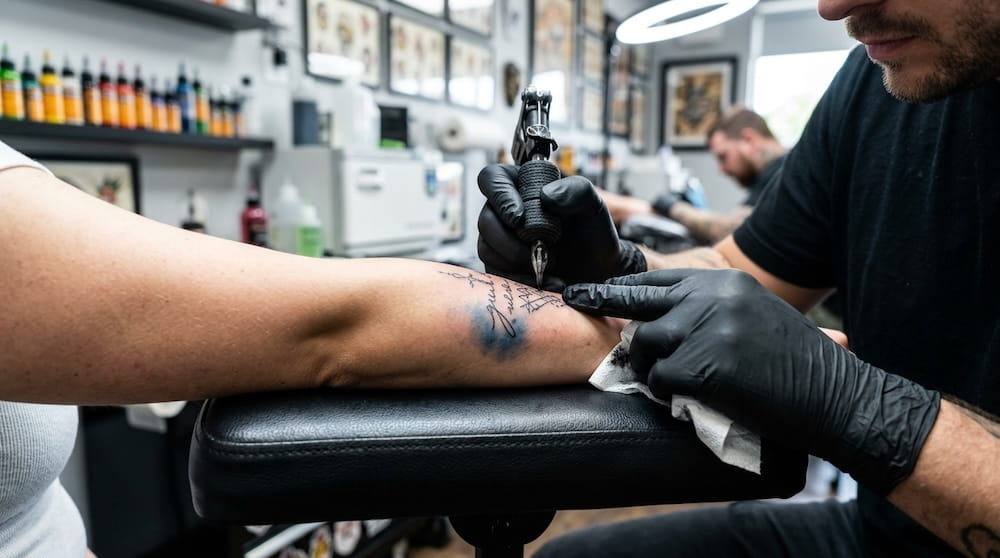
If, shortly after getting tattooed, you notice certain lines look "runny," with bluish or greenish shadows extending beyond the stroke, you’re probably seeing a blowout. It’s one of the most feared (and misunderstood) topics for both clients and artists.
Blowout is essentially ink that has spread into skin layers where it wasn’t meant to sit. That makes lines less crisp, thicker than intended, or surrounded by a fuzzy halo. Understanding why it happens helps separate myths from reality and leads to better decisions before and after you get tattooed.
What exactly is tattoo blowout?
In a well-executed tattoo, ink is deposited in the dermis at a controlled depth. If the needle goes too deep or at a poor angle, pigment can reach softer tissue layers where body pressure pushes it outward, sideways.
This "spreading" doesn’t happen like wet ink dripping in real time. It usually becomes apparent over days or weeks, as swelling subsides and the pigment’s final position reveals itself.
The visual impact ranges from a subtle halo visible only up close to more obvious distortion—especially on very thin skin, highly mobile areas, or in fresh pieces from inexperienced artists.
Most common causes of blowout
Not all blowouts are the same or caused by the same thing. Sometimes technique is the main issue; sometimes anatomy or client movement plays a role. Still, there are scenarios where risk clearly increases.
Areas like wrists, hands, feet, ankles, or ribs have thinner or more stretched skin during the session. When that stretch is released, tissue can shift, and ink that was already on the edge of depth tolerance may spread more visibly.
- Factors that raise blowout risk:
- Needle going too deep or excessive pressure.
- Poor needle angle while lining.
- Very thin skin or over-stretched skin during tattooing.
- Client moving abruptly during delicate linework.
- Working too fast on challenging areas (hands, feet, neck).
Is it always the artist’s fault?
Technique is a key factor, and a skilled artist knows how to adjust depth, speed, and skin tension. That said, some bodies and placements have a much smaller margin for error, and even careful artists can see minor blowout in certain segments.
That’s one reason to choose someone with specific experience in the body area you want to tattoo and to pay attention when they advise against ultra-delicate designs there (like ultra-fine lines on ankles or feet).
A very pronounced blowout in multiple areas of the same piece can be a red flag for poor technique or inexperience. A very mild halo on a tricky spot, by contrast, doesn’t automatically make the artist "bad"—it’s a known risk of working on living skin.
Can blowout be fixed?
It depends on severity and design. In some cases, lines can be thickened, reshaped, or blended into shading so the halo becomes less obvious. In others, a partial or full cover-up is the best bet, integrating the blowout area into a larger design.
Simply "tattooing skin color" over the blowout or layering white/beige on top rarely works long term. It can add more pigment layers and produce even stranger results as the tattoo ages.
In select cases, some people opt for laser to reduce the spread pigment, then rework the area with a modified design. That route requires serious planning and realistic expectations, not promises to "erase it like new".
How to reduce the chances beforehand
You can’t guarantee you’ll never see any blowout, but you can reduce the odds and the impact. Choose an artist with a strong track record of clean lines, listen to minimum size recommendations, and be strategic about placement.
If you want ultra-fine lines on high-movement, high-friction areas, your artist should explain what might happen as the tattoo ages. Sometimes the smartest move isn’t to skip the tattoo, but to adjust the design so that even if some spread occurs, it still looks good.
If you already have blowout and it bothers you, bring clear photos and your expectations to a reputable studio. From there, the conversation can focus on real options: disguise, redesign, or using the experience to choose better for your next piece.


