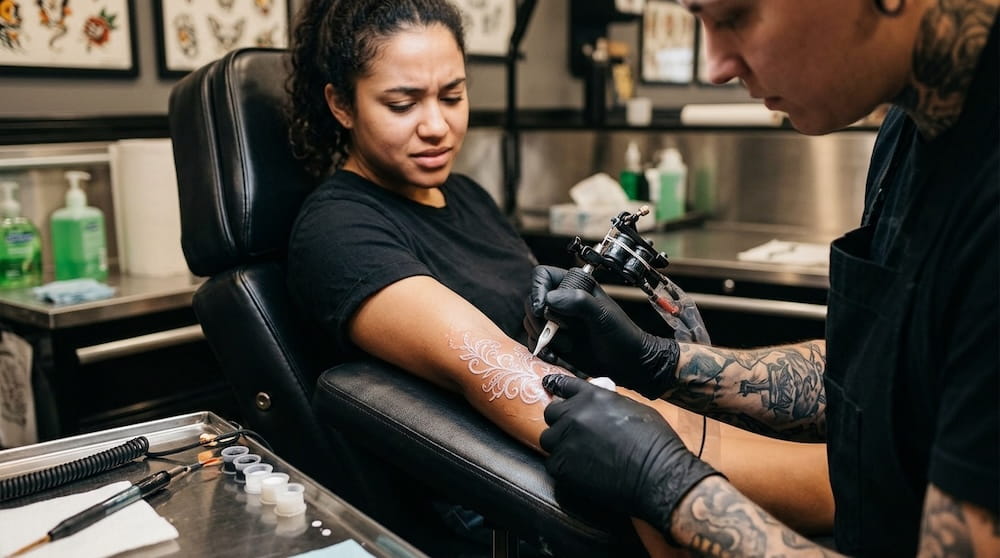
On social media, white tattoos often look bright, delicate, and almost glowing on clean skin. But most honest tattooers will tell you the same thing: white ink on real skin almost never ages like those fresh photos. Over time, these tattoos can look yellowish, grayish, or simply fade away.
Understanding why doesn’t mean you can’t use white—it means you should use it with realistic expectations. Your skin isn’t a blank canvas: it has tone, texture, blood vessels, melanin, and lives in a world with sun, friction, and constant change.
Where white ink sits and how it actually looks
Like any tattoo ink, white sits in the dermis, under the surface layer of skin. The color you see is the result of light traveling through the epidermis, bouncing off pigment, and coming back out. On very light, well-cared-for skin, white can stand out more; on darker skin, the contrast is naturally reduced.
Ink is not a perfectly opaque, flat layer. There’s always some visual blending between your skin tone and the pigment. That’s why what you see on day one (with mild swelling and fresh pigment) is not the final result. As skin settles, white tends to soften—and for many people that means becoming much less visible.
On darker skin tones, white can end up reading more like a slightly raised, lighter texture than a crisp, graphic mark.
Why white tends to yellow
Several factors drive yellowing. One is pigment chemistry: some white pigments can oxidize or shift tone over time. Another is the environment: continuous sun exposure, skincare products, pollution, and changes in skin pH and moisture.
Your skin also produces keratin and oils that build up over the pigment. In combination, that can turn a cool, bright white into something warmer—what many people describe as "dirty yellow".
Placement matters too. In high-friction areas (hands, fingers, ankles, neck), skin renews more aggressively and the perception of white changes faster.
When white makes sense (and when it doesn’t)
White usually works best as a supporting element inside a design that relies on other colors or black—highlights, small light points, or subtle accents. If white softens over time, the design still holds because its main structure is built on stronger values.
By contrast, tattoos made almost entirely of white—especially on more pigmented skin or sun-exposed areas—tend to disappoint in the long run. They can look amazing when fresh, but their 2–3 year reality often doesn’t match the original reference.
If an artist hesitates about your all-white concept, that’s usually not a lack of skill—it’s experience. They’ve likely seen how these age and don’t want to promise what biology won’t deliver.
How to use white more intelligently
If, after understanding the trade-offs, you still love white, you can frame it wisely. Combine it with fine black or gray linework. Place it in lower-sun areas. Treat it as a subtle accent, not the sole anchor of the piece.
It’s also crucial to accept that you may need touch-ups if you want to keep it noticeable. A "low-maintenance" full white tattoo is almost a contradiction: by nature, it’s delicate and more prone to visible change.
- Before committing to white ink, ask yourself:
- Would I still like it if it became very subtle or nearly invisible?
- Am I willing to protect it aggressively from the sun?
- Would I accept a future touch-up if it loses strength?
- Is it smarter to use white as a highlight in a stronger design?
In short, white tattoos aren’t “bad”—they’re just less stable and predictable. If you use them, do it knowing what pigment and skin can realistically offer over time. A good artist will help you place white in ways where its limitations don’t ruin the piece as it ages.


