When you decide you want to transform an existing tattoo, you immediately face a question that can have a huge impact on the final result: do I do a direct cover-up or first go through laser sessions? The correct answer depends on specific characteristics of your tattoo that no artist can evaluate without seeing it, but there are clear principles that will help you understand the logic behind this decision.
At Legassy Studio we've worked with both approaches and have learned with precision which cases benefit from prior laser and which can be resolved directly with a good coverage design. In this article we share that knowledge with you.
The basic logic: why laser before a cover-up?
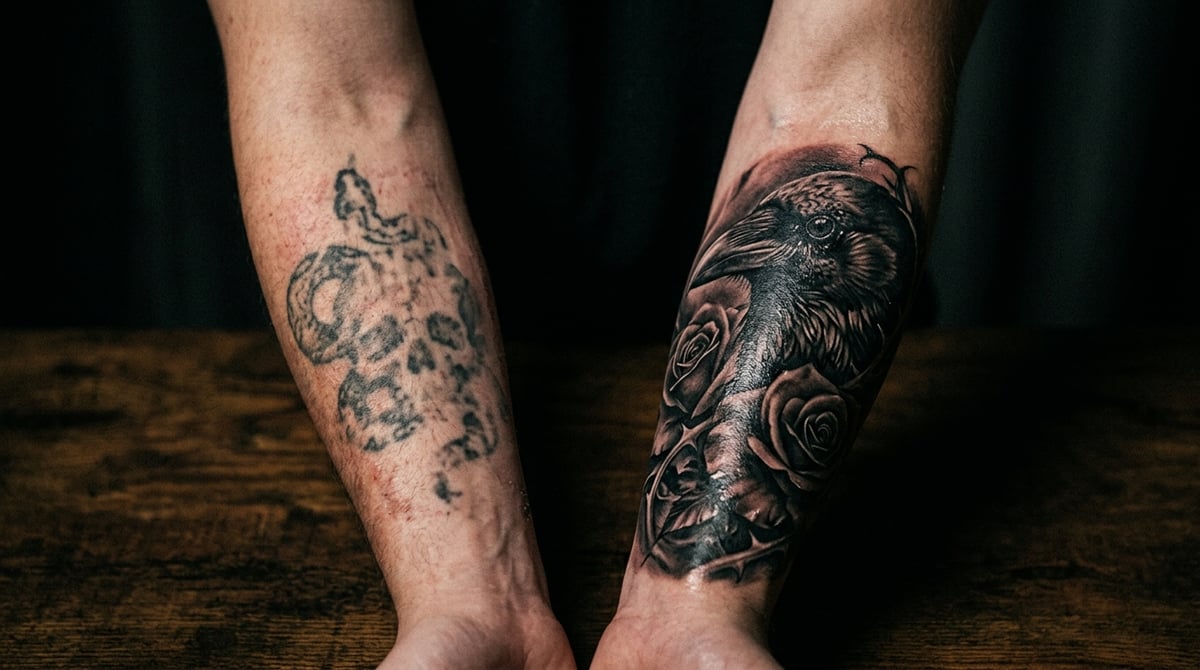
Tattoo removal laser works by fragmenting ink particles in the skin so the immune system can absorb them over time. It doesn't remove ink instantly: it degrades it session by session, gradually lightening the tattoo. In the context of cover-ups, laser isn't used to completely remove the tattoo, but to lighten it enough to give the artist more creative and technical freedom when designing the new tattoo.
When a tattoo is very dark and densely saturated, the cover-up artist has very limited options: the new design must be significantly larger than the original and use dark or black ink to neutralize what lies beneath. With 2 or 3 laser sessions that lighten the tattoo by 30% to 50%, suddenly the artist can work with a much wider palette, smaller designs, and notably cleaner results.
When is laser necessary before a cover-up?
We recommend the laser + cover-up approach in the following cases:
- Tattoos with solid black fill: If the original tattoo has large areas with compact black ink, any cover-up without prior laser will be very limited in style and color options.
- Heavily saturated black tattoos on small areas: When the original tattoo is relatively small but very dark, the cover-up would need to be disproportionately large to cover it. Laser allows reducing that proportion.
- When the client wants a specific design incompatible with the original ink: For example, if you want a fine-line or watercolor tattoo over a dark tattoo, laser is practically essential.
- Tattoos in visible areas where the result must be impeccable: Neck, wrists, hands, face: in these areas the margin for error is minimal and prior laser gives much more control over the result.
When is a direct cover-up sufficient?
Direct cover-up, without laser, works perfectly well in many cases:
- Tattoos with fine lines or little ink that have naturally aged and lightened.
- Tattoos more than 10 years old that have significantly degraded.
- Medium or large tattoos where the client accepts a cover design that's also large, in realism or blackwork.
- Tattoos with faded colors (not solid black) that a realism design can absorb without difficulty.
How many laser sessions are needed?
For the combined approach, generally not many laser sessions are needed. The goal isn't to eliminate the tattoo but to lighten it. Between 2 and 5 laser sessions are usually sufficient to reduce ink density as needed, depending on the tattoo. Each session should be separated by at least 6–8 weeks for the immune system to absorb the processed ink fragments.
The exact number of sessions depends on the size, depth, and colors of the original tattoo. Blacks and blues respond better to laser. Greens and yellows are more resistant. Your laser professional will give you a more precise estimate after evaluating your specific case.
How long does the combined process take in total?
This is the point that most surprises clients. The laser + cover-up process can take between 6 months and over a year in total:
- Laser sessions: 2–5 sessions with 6–8 weeks between each.
- Rest period after last laser session: minimum 3 months before cover-up.
- Cover-up session: 1–3 sessions depending on size and complexity.
It's a significant time investment, but the final result is completely different from what you'd get with a rushed cover-up over a dark ink base. If the tattoo you want to transform is visible and you'll carry it forever, the additional time is absolutely worth it.
Next steps if you're considering this option
If you think your case may require laser before the cover-up, the ideal process is to first consult with a tattoo removal laser specialist to assess how many sessions you'd need, then schedule a consultation with our team at Legassy Studio so the artist can evaluate the laser result and design the definitive cover-up. We can coordinate both parts of the process if you need it.
The financial perspective on laser + cover-up vs. direct cover-up
One consideration that often surprises clients is the total investment comparison between these two approaches. At first glance, adding laser sessions to the process might seem to significantly increase the cost. But when you factor in the quality of the final result and the alternatives, the math often tells a different story.
A direct cover-up on a dense, dark tattoo may require a design 2–3 times larger than what the client originally wanted, in styles limited to dark or black-heavy work. If the client isn't happy with those constraints, they may end up needing additional work anyway — more sessions, more modifications, or eventually laser removal of the cover-up itself. This scenario costs far more in the long run than planning correctly from the start with a few targeted laser sessions.
The laser + cover-up approach also gives you access to more artistic possibilities at the same total investment. Instead of a large blackwork cover-up by necessity, you might achieve a medium-sized fine line or neo-traditional piece — exactly what you wanted — because the laser gave the artist the clean canvas they needed. At Legassy Studio we always discuss the economics of each path transparently before any commitment is made.